
About the Guide
Healthcare organizations have invested heavily in cybersecurity, governance, and compliance over the past two decades. Yet modern attacks increasingly exploit the relationships between cloud services, enterprise identity, medical devices, third-party technologies, and AI-enabled workflows rather than a single vulnerable system.
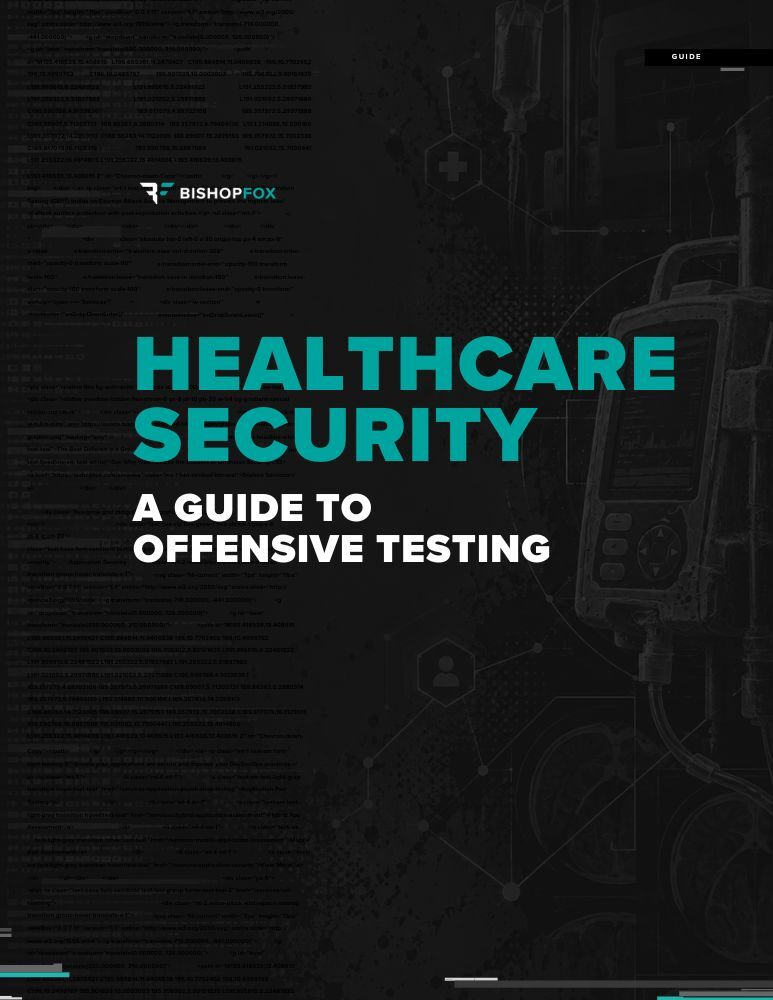
Healthcare Security: A Guide to Offensive Security examines how those changes have reshaped the healthcare attack surface and why offensive security provides a different lens for understanding cyber risk. The report explores how modern attacks unfold, where traditional assurance reaches its limits, and how organizations can use security testing to build confidence in the systems that support patient care.
To better understand those trends, Bishop Fox analyzed 160+ offensive security assessments that were conducted across 40+ healthcare organizations, representing 825 individual security findings collected from 2024-2026. Those insights are paired with anonymized customer case studies and publicly documented healthcare incidents to identify recurring attack paths, common security challenges, and practical opportunities to strengthen cyber resilience.
What the Guide Covers
Modern healthcare security depends on understanding how technologies interact, not simply how they operate in isolation. This report explores:
- Why healthcare continues to be one of the world's most targeted industries for cyberattacks
- Why compliance alone cannot demonstrate security resilience
- How cloud services, enterprise identity, medical devices, healthcare AI, and third-party technologies have reshaped the healthcare attack surface
- Why identity-related weaknesses consistently produce the most severe findings
- How offensive security reveals attack paths that traditional assessments often miss
- How to build a security testing strategy that evolves alongside modern healthcare environments
Why We Wrote the Guide
Most healthcare cybersecurity guidance focuses on regulatory requirements, defensive controls, or technology-specific best practices. Those remain important, but they don't answer a fundamental question:
Can your security controls withstand the way modern attacks actually unfold?
This report bridges the gap between documented controls and demonstrated resilience by combining offensive security research with practical guidance for healthcare organizations navigating an increasingly connected technology ecosystem.
Who Should Read the Guide
This report is intended for leaders responsible for protecting modern healthcare environments, including: Chief Information Security Officers (CISOs), healthcare security leaders, security architects, clinical engineering and biomedical teams, medical device security professionals, healthcare technology providers, and risk and compliance leaders.
Whether you're evaluating healthcare AI, strengthening medical device cybersecurity, expanding offensive security capabilities, or refining your organization's security testing strategy, this report provides practical guidance grounded in real-world healthcare engagements.