


TL;DR
- Every active vulnerability scanner eventually has to answer the same question in an ICS/OT environment: What happens if this check is the thing that finally crashes a twenty-year-old PLC that has never been rebooted? Most tools answer it by not scanning that environment at all.
- We built icsScanner to answer it differently: fingerprint the target before every single probe, rate-limit and poll for liveness around anything risky, and cap every finding's confidence at what the evidence actually supports.
- For the small number of findings whose worst case is physical rather than informational, there is an entirely separate architectural tier that cannot be reached from either of the tool's own entry points.
What is icsScanner?
icsScanner is an active vulnerability scanner built specifically for industrial control systems and operational technology networks: the programmable logic controllers (PLCs), protection relays, remote terminal units (RTUs), and supervisory control and data acquisition (SCADA) infrastructure that sit between a corporate network and physical equipment. Every check it ships is gated behind a device fingerprint that must match before a single byte is sent, is rate-limited globally and per-target, and reports a confidence level capped at what its evidence actually supports. It currently covers 250 checks across 29 protocol families, including Modbus, S7comm, OPC UA, PROFINET, EtherNet/IP, DNP3, and IEC 104, among others.
Shad Malloy started his civilian career building industrial control networks for heavy industry. Those industries focus heavily on safety briefings and lock-out/tag-out because the failure to consider safety could have life-changing consequences. The hope is that the instrumentation and control (I&C) technician viewpoint brought to this tooling shows the same level of concern for the current generation.
Zoe Duncan joined the project after meeting Shad at Summercon in Brooklyn and found their skills overlapped. She works in security operations, where the question is usually the mirror image of Shad’s: not whether a check is safe to run, but whether a defender would recognize it happening. That question shaped the companion detection-gen project this post's methodology feeds, covered in the next post.
Why ICS/OT Scanning is a Different Problem
An IT vulnerability scanner's worst-case failure mode is usually a crashed service that restarts on its own, or a false positive that wastes an afternoon. An ICS/OT device's worst-case failure mode can be a substation relay that needs a truck roll to power-cycle, or a flow computer that drops out of a process it was actively controlling.
Tenable (whose Nessus product has one of the most mature SCADA plugin families in the industry) tells its own customers not to actively scan fragile OT devices at all. That is not caution for its own sake. It is an honest admission that the scanning model built for IT does not have anywhere to put the extra layer of care this domain actually requires.
The Gap, In Full
We surveyed the existing tooling landscape before writing a line of code, specifically to find out whether this gap was real or just something we assumed.
Tool | What it does well | Why it does not close the gap |
Nessus (Tenable) | Mature SCADA plugin family built over years; real depth | Closed-source and commercial. Its own stated posture toward active OT scanning is caution bordering on avoidance; it manages around the safety problem rather than solving it |
Nuclei | YAML template DSL sends raw TCP/UDP hex probes, which is most of what an ICS check needs at the wire level | ICS-specific template content is thin, and the DSL is awkward for the multi-step, stateful sessions many real ICS protocols require |
Metasploit | A handful of SCADA scanner modules | Largely dated to the 2014–2016 era, and skewed toward exploitation rather than safe verification |
nmap NSE | Genuinely excellent device fingerprinting; modbus-discover, s7-info, dnp3-info, enip-enumerate | Stops there by design. No CVE-level vulnerability checking anywhere in that layer; it is a discovery tool |
geeknik/scada-scanner | Closest direct competitor: async, multi-protocol, real vulnerability database, a --safe-mode flag | Safe mode is opt-in. In icsScanner, safety is the default and you must explicitly ask for anything riskier, the one design choice we deliberately inverted |
Put together, the verdict was clear before we wrote any check logic: discovery, in this space, is a solved problem. Safe, active, CVE-specific checking is not. That is the gap.
The Safety Architecture, as it Actually Evolved
The core discipline is simple to state and easy to get subtly wrong in practice: fingerprint before you probe, always. No check runs unless the target's vendor, product, or a live protocol-identity check first confirms it is plausibly the kind of device the underlying CVE actually affects. Software-only findings get a narrow, explicitly justified escape hatch from the hardware-vendor requirement, but that escape hatch is hard-banned for anything destructive, so it can never become a safety bypass for the checks where it matters most.
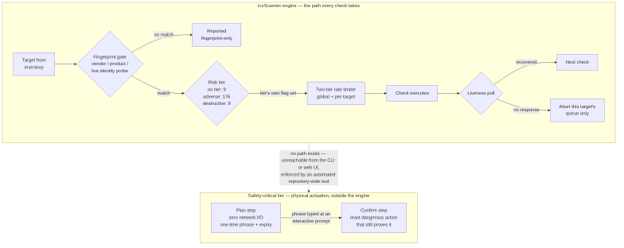
Every risky action lives behind a two-tier split. Adverse covers things like login attempts: real risk, since account lockout policies exist for a reason, but recoverable. Destructive is the stricter tier, for anything that writes device state or could otherwise leave a mark that is not a simple failed-login counter. Neither tier fires without an explicit flag at runtime, and the two flags are independent of each other rather than one being a superset of the other. The default posture reports what is fingerprint-confirmed and stops there.
Around any check that could degrade a live connection, the engine polls for liveness before and after, and if a target does not recover it aborts that target's remaining queue, not the whole scan. Rate limiting is two-tiered the same way: a global cap across every target running concurrently, and a separate per-target cap, so aggressive concurrency in general cannot translate into aggressive pressure on any one device.
Every finding also carries its own confidence ceiling, independent of whether the underlying CVE is real. High confidence requires an exact version match or genuinely demonstrated behavior; everything else, such as a banner heuristic or a vague advisory, is capped at low, and a run can never report above the ceiling the check itself declares. Status reporting mirrors that honesty: four states rather than a Boolean, so a report cannot imply more certainty than the evidence supports.
The Mistake We Caught
We would be understating the story if we made this sound like it worked perfectly from day one.
At one point, the fingerprint-gating logic, the single biggest safety lever in the whole architecture, had a real gap. The registry validated that every check declared a fingerprint precondition at load time, but nothing at scan time ever actually checked whether a live target matched it. Every check built up to that point had been running unconditionally against every target for a full development milestone before we caught it.
We found it, fixed it, and the gate now runs before every single check, cached per protocol-checks so it does not add redundant traffic, and rebuilt the safety-milestone tests to prove the gap was actually closed rather than just patched over. It is the kind of mistake this whole architecture exists specifically to prevent, and it happened anyway. That is exactly why we do not treat "we designed it to be safe" as the same claim as "we verified it is safe."
Why a Third Tier was Necessary
Data exposure and physical actuation are not the same risk, and treating them the same is how you end up with a scanner that can accidentally move a robot arm because someone forgot to gate a flag carefully enough.
A handful of real findings across this project's history do not fit anywhere in the normal check architecture at all. An unauthenticated TCP command interface on a collaborative-robot controller, the finding that originated this tier, includes real motion functions among its exposed commands, not just status queries. A default-passcode finding on a protection relay family unlocks a command set where every single option mutates real device state, and two of those options are direct circuit-breaker open and close commands.
For findings like these, the safety-critical tier exists as a hard architectural wall. Three requirements, non-negotiable:
- Unreachable from the tool's own entry points. Neither the CLI nor the web UI can invoke it, enforced by an automated test that scans the whole repository for stray references rather than trusting a comment.
- No single command goes from nothing to a live connection. A planning step with zero network I/O writes out the exact target, the exact bytes, and a random one-time confirmation phrase with an expiry. Only a separate confirmation step, requiring that phrase typed back at an interactive prompt, never a command-line flag, actually connects.
- Whatever gets sent, once confirmed, is always the least dangerous action that still proves the finding.
The protection-relay case is the sharpest example of what that discipline actually costs. Every password-gated command on that device mutates something real. We picked the least consequential one available, a command that appends a single record to a bounded, already-rotating diagnostic buffer, stated the real side effect plainly in the tool's own output rather than implying it was harmless, and left the two breaker-control commands out of the code entirely. Not disabled behind a flag. Structurally absent, with no constant anywhere in the module that could be flipped back on.
That is the actual test of a safety architecture: where possible choose the least impactful option, and do not include the options to prevent unintentional safety conditions.
Why This Matters
In December 2017, the Triton malware was discovered on a Saudi petrochemical plant's Triconex safety instrumented systems, the controllers whose entire job is to bring a process to a safe state when something goes wrong. The attackers were not after data. They were on the equipment that exists to prevent an explosion, and the intrusion was only discovered because a coding error tripped a plant shutdown.
Triton is the reason this project treats physical actuation as its own risk category rather than a more severe grade of data exposure. The two are not the same kind of problem:
|
Informational risk |
Physical-actuation risk |
|
|
Worst case |
Data disclosed, credentials exposed |
Equipment moves, a breaker opens, a process trips |
|
Reversibility |
Rotate credentials, revoke access |
Truck roll; potentially a safety event |
|
Who is affected |
The asset owner |
Anyone physically near the equipment |
|
How icsScanner handles it |
Normal check, tiered and flag-gated |
Separate tier, plan/confirm split, dangerous commands never implemented |
An assessment tool operating in this environment inherits that distinction whether or not its architecture acknowledges it. Most scanners do not acknowledge it, which is precisely why their own vendors advise against pointing them at OT.
Detection and Mitigation
The controls that actually reduce exposure in the environments we assess are unglamorous and mostly architectural:
- Segment the management plane. Almost every finding in this scanner's default-credential families requires reaching a web, Telnet, FTP, or SSH management interface. Most of those interfaces should not be reachable from a general-purpose network at all.
- Change factory credentials. A substantial majority of the 250 checks target documented factory defaults. These are published by the vendors themselves, in support articles and configuration-tool templates; they are not secrets.
- Disable unused management services. Several checks return not applicable simply because the FTP or Telnet server was turned off. That is the mitigation working.
- Inventory by fingerprint, not by port. The single most useful thing an asset owner can have before an assessment is an accurate map of what is actually on the wire. The scanner's discovery mode exists precisely because that map usually does not exist.
- Watch the management plane for authentication attempts. Detection content for these findings is generated directly from the same check metadata.
What We See in Real CEngagements
- Factory-default credentials on management interfaces are not an edge case. They are the single largest category of finding in this scanner's inventory, and they persist because the devices were commissioned by an integrator years ago and nobody has logged in since.
- The asset inventory is almost always wrong. Not maliciously: the plant grew, an integrator swapped a unit, and the drawing never got updated. The first useful output of an ICS assessment is frequently the device list itself.
- "Air-gapped" usually means "not routed on purpose." There is a jump host, or a vendor maintenance laptop, or a cellular modem installed for remote support.
- The people responsible for these networks are not the people who chose the equipment. The operations team inherited a fleet with a twenty-year service life and no realistic patch path. Recommendations that assume otherwise get filed and ignored.
- Fragility is real, not folklore. Devices in this space genuinely do fall over under ordinary scanning traffic. The caution the industry advises is earned.
A check needed evidence, not just an interesting idea
As the research expanded, the project accumulated candidate checks as well as checks supported by the documentation needed to move them forward. Shad described that distinction simply: some checks were established, while candidates still needed a document or another supporting source before promotion. Keeping those categories separate made it possible to continue researching a lead without presenting it as a confirmed finding.
The split is not cosmetic. Today there are 250 promoted checks and 275 candidates, more material waiting on evidence than has cleared it.
That distinction mattered when we considered what the scanner's results would mean to someone else. A potential weakness, a documented check, and a validated vulnerability were not interchangeable claims. We needed to know what the available evidence actually supported, particularly when research might eventually become part of a vendor disclosure. Candidates need primary evidence before they can be promoted. This may be a vendor document, a real web endpoint to validate traffic against, or checks against real firmware.
Results and Coverage
|
Real checks |
250 |
|
Protocol families |
29 — Modbus, S7comm, OPC UA, PROFINET, EtherNet/IP, DNP3, IEC 104, SNMP, HTTP, FTP, TFTP, MQTT (including a Sparkplug B passive listener), Telnet, SSH, VNC, MSSQL, PCOM/TCP, InduSoft agent protocol, Red Lion Crimson, GE GeoSCADA, SECS/GEM HSMS, Mitsubishi MELSEC SLMP, Omron FINS, LS Electric XGT, Cisco Smart Install, Franklin Fueling, Veeder-Root ATG, Opto 22 OptoMMP, Robotis RoboPlus Motion |
|
Candidate findings (researched, not yet promoted) |
275 |
|
Checks behind the adverse tier (login attempts) |
210 |
|
Checks behind the destructive tier (device write or confirmed lockout) |
10 |
|
Checks requiring no risk flag at all |
30 |
|
Safety-critical tier tools |
9 |
|
Disclosure posture of promoted checks |
249 public, 1 disclosed-fixed, 0 disclosed-pending-fix |
|
Vulnerability feed integrations |
CISA CSAF 2.0, Japan's MyJVN, ENISA EUVD, the ICS Advisory Project |
Detection, Not Just Discovery
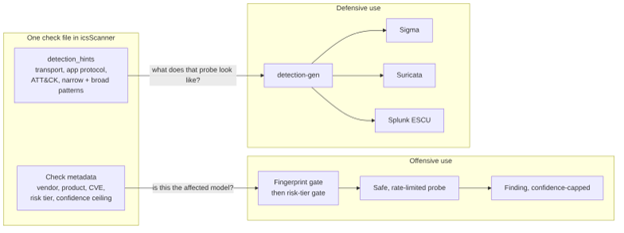
Every check icsScanner ships already carries the metadata to describe what an exploitation attempt of it looks like on the wire. That is not wasted. Our companion tool, detection-gen, reads that same metadata directly and generates real Sigma, Splunk ESCU, Zeek, and Suricata templates from it.
Finding the vulnerability and detecting the attempt to exploit it come from the same source file, not two efforts maintained separately.
One source of truth, two audiences
Here is the part that matters more than either tool individually: detection-gen does not guess at what to detect. It reads the same file icsScanner uses to decide whether and how to test for a vulnerability, and turns it into what a defender should watch for if someone else runs that exact test against them.
|
icsScanner reads it as |
detection-gen reads it as |
|
|
The same check file |
Is this device the affected model, and is it safe to probe? |
What does that check look like on the wire? |
|
Narrow pattern |
The exact bytes this check sends |
Alert when this specific probe is seen |
|
Broad pattern |
The vulnerability class the check belongs to |
Alert on variations of the same activity |
|
Absent pattern |
Nothing; the check still runs |
No rule generated; the trigger is rate-based or structural |
The check that says "this device is vulnerable to X" and the detection that says "here is what X looks like on your network" come from one shared source, not two efforts that drift apart over time.
Closing Thoughts
We built icsScanner because the honest answer to "can you safely check this environment for known vulnerabilities?" was, for too long, "not with anything that exists today." That is not a knock on the tools that came before it: Nessus, Nuclei, nmap NSE, and Metasploit all do real, useful work in adjacent layers of this problem. It is a statement about what a genuinely safety-first architecture requires that a general-purpose scanner design does not have room for: fingerprinting before every probe, a confidence ceiling that cannot be talked past, and an entirely separate, harder-to-reach tier for the small number of findings where the worst case is physical.
If you assess critical-infrastructure environments, or if you are the team on the other side of that assessment, trying to know what is actually reachable in your own environment before someone else finds out, this is built for exactly that work.
Get the code
- icsScanner: https://github.com/BishopFox/icsScanner
- detection-gen: https://github.com/BishopFox/icsScanner/tree/main/detection-gen
icsScanner is for authorized security testing of systems you own or are contracted to assess. Active probing of industrial control equipment can disrupt physical processes.
Subscribe to our blog
Be first to learn about latest tools, advisories, and findings.
Thank You! You have been subscribed.
Recommended Posts
You might be interested in these related posts.